
 LT
 DE

A radiator-cooled gaming PC sounds like a joke until you see that it is a real, working modding project: modern PC hardware connected to a Victorian cast-iron radiator that not only looks decorative but also performs a cooling function.
Technology media reported on this unexpected solution, and the idea itself quickly spread among enthusiasts because it brings together several topics at once: extreme DIY engineering, aesthetics, and a very practical question—how to dissipate the heat generated by a powerful GPU and CPU.
When discussing water cooling, we usually imagine a compact radiator with dense aluminum or copper fins and several fans. What makes this story interesting is that instead of a typical PC radiator, it uses a massive, thick, heat-retaining cast-iron radiator—an object more commonly found in older homes than next to an RTX-class graphics card.
Radiator-Cooled Gaming PC: From Heating a Room to Managing GPU Temperatures
At first glance, a project like this looks like an art installation, but its logic is quite straightforward: if a heating radiator is designed to release heat into a room, why not use it to disperse the heat generated by computer components?
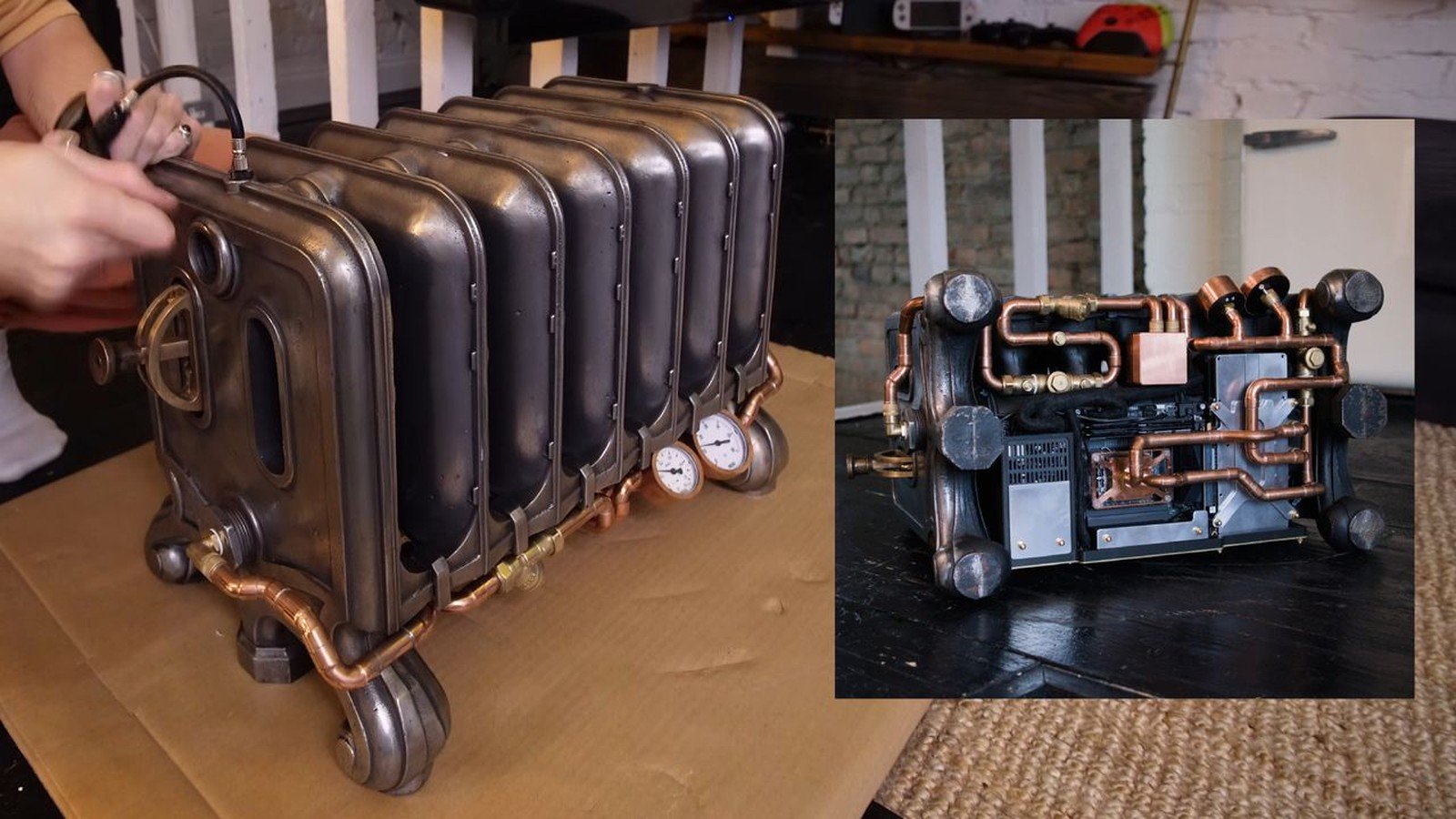
The key difference is that a traditional household radiator usually operates under entirely different conditions from a computer cooling loop. Home heating systems generally circulate water or a mixture at higher flow rates and often at higher temperatures, while a PC water-cooling loop prioritizes stability, leak prevention, and component safety. The coolant typically contains additives to prevent corrosion and algae, while all parts are selected to ensure that their materials do not react badly with one another.
Nevertheless, the physics of heat works in the creator’s favor here. The mass of the cast iron can act as a large heat “reservoir” through its thermal capacity, while its large surface area serves as a passive means of releasing heat into the air. In other words, even if such a radiator is not as efficient per square centimeter as a modern thin-finned PC radiator, its overall size and mass can compensate for some of the difference.
How Does a Radiator-Cooled Gaming PC Work, and How Does It Differ From Conventional Water Cooling?
To understand what makes this idea special, it is worth remembering what a water-cooling system in a gaming PC usually looks like. A typical loop includes a water block on the CPU, often a separate block on the GPU, a pump, a reservoir, flexible tubing or hardline pipes, and a radiator with fans. Heat is transferred from the chip through the block into the coolant, the coolant carries it to the radiator, and the radiator releases the heat into the air.
The most interesting part of this story is that the role of the radiator is taken over by a household cast-iron radiator. The practical implementation can vary, ranging from coolant flowing directly through the radiator’s internal channels to an intermediate solution involving a heat exchanger, where the PC loop is separated from the radiator loop. Both options have advantages and disadvantages, and this system-level aspect is precisely what separates the concept from a merely attractive case.
If coolant flows directly through the cast-iron radiator, maximum heat transfer into that mass can be achieved, but questions about material compatibility arise. If a heat exchanger is used, it is possible to maintain a safe PC loop built from conventional materials such as copper, nickel, and brass, while the cast-iron radiator becomes a separate heat-dissipation module. However, this adds another heat-transfer stage, which may reduce overall efficiency.
Another difference is airflow. In PC radiators, fans create a directed flow through the fins, allowing heat to be removed very efficiently. A cast-iron radiator usually relies on natural convection: the air warms up and rises, while cooler air takes its place. This means that such a solution can be very quiet and operate passively, but its immediate cooling capacity will depend on airflow within the room, the radiator’s position, and the temperature difference.
A Victorian Cast-Iron Radiator as a Cooling Component: Design, Weight, and Practicality
Cast-iron radiators are often valued for their appearance: decorative patterns, substantial forms, and historical character. In the modding world, this is almost the perfect material for a project with a story, especially when aiming for a steampunk or industrial style. However, aesthetics are only half of the story.
In practical terms, a cast-iron radiator is heavy and massive. This immediately raises mechanical questions: how the computer is mounted, where the center of gravity is located, and whether the structure is safe during long-term use. If the radiator needs to be moved, it is not the same as lifting a conventional PC case—objects like this often weigh dozens of kilograms. Projects of this kind therefore usually require precise planning, covering everything from mounting hardware to vibration reduction and impact protection.
Another consideration is surface temperature. If the radiator becomes hotter than a typical PC radiator, it turns into a heat source within the room. For some people, this is an advantage, providing additional heating during winter. For others, it is a drawback, because during summer the goal is to reduce the thermal load rather than add to it. It is also important to design the system so that accidental contact does not create a burn risk, especially in homes with children or pets.
Real-World Efficiency: Temperatures, Noise, and “Heat Recycling”
The biggest question that arises when reading about a project like this is simple: does it actually cool well? There is no single definitive answer because everything depends on the specific implementation, including the flow rate, coolant, pump, water blocks, radiator condition, room temperature, and even whether additional fans are used.
However, several general principles can be identified. First, a large thermal mass helps smooth out sudden temperature spikes. If the load suddenly increases while gaming or rendering, the radiator can absorb some of the heat and prevent the system from heating up as quickly. This does not mean that temperatures will be miraculously low, but the spikes may be smaller, which can sometimes improve stability.
Second, there is noise. The fewer fans there are and the lower their rotational speeds, the quieter the system will be. If the cast-iron radiator can passively dissipate enough heat, the entire system could become exceptionally quiet, which is one of the most valued qualities in the high-end PC segment. Even if fans are used, fewer may be needed, or they may be able to spin more slowly than in a traditional compact case.
Third, there is heat utilization. A conventional gaming PC simply blows heat into the room through its case fans. The radiator-based solution makes this process more orderly and, in a sense, more purposeful: the heat is released through an object that was historically designed for exactly that task. This is more of a philosophical advantage, but it resonates with ideas of sustainability, especially when discussing high-powered systems that generate hundreds of watts of heat.
Engineering Challenges: Leak Prevention, Coolants, and Corrosion Risks
All water-cooling projects share one fundamental rule: water and electronics get along only as long as everything remains perfectly sealed. When an old cast-iron radiator is added to the equation, the number of challenges increases.
One of the most important issues is corrosion and material compatibility. PC water-cooling loops generally try to avoid mixing different metals that can cause galvanic corrosion, such as aluminum and copper. A cast-iron component adds another metal with its own characteristics. If the system is designed carelessly, deposits and rust may develop over time, flow may become restricted, or leaks may even appear. Projects like this therefore usually require either a suitable coolant with corrosion inhibitors, structural separation through a heat exchanger, or a carefully planned combination of metals.
The internal condition of the radiator is equally important. An old radiator may contain dirt, deposits, or microcracks that might not cause problems in a heating system but could become critical within a PC cooling loop. Before integration, it is therefore logical to expect thorough preparation, including flushing, leak checks, appropriate fittings, and pressure testing.
Maintenance is another consideration. Replacing or cleaning a conventional PC radiator is relatively simple, while maintaining a cast-iron radiator requires more physical effort and logistical planning. This means that such a solution is better suited to enthusiasts who enjoy the process than to users who want a “set it and forget it” system.
Who Actually Needs a Solution Like This? Modding Culture and Technological Curiosity
Although practical efficiency is the first question for many people, the modding scene often revolves around different values: originality, craftsmanship, and the idea itself. That is exactly what makes this story so fascinating—it is not just another glass case filled with RGB lighting, but an attempt to rethink where the computer ends and its surroundings begin.
Projects like this also demonstrate how many different areas of expertise come together in a single build: thermodynamics, fluid circulation, materials science, mechanics, electrical safety, and even interior design. That is why they are inspiring. Even if people do not begin mounting PCs on cast-iron radiators on a large scale, the idea itself encourages the search for unconventional solutions.
Ultimately, it is also a form of communication. On social media and within enthusiast communities, builds like this serve as a “visual argument”: a PC can be more than just a box under a desk—it can be an object worth displaying. When that object also performs a practical function, it gains additional value.
Can a Project Like This Be Recreated at Home?
In short, theoretically yes, but in practice only if you have the necessary skills, tools, and patience. The most important thing to understand is that this is not a weekend-level DIY mod. Even experienced water-cooling enthusiasts will encounter additional variables that increase the risk.
If someone wanted to pursue a similar approach, the first step would be to define the architecture clearly: whether the cast-iron radiator will be a direct part of the PC loop or whether a heat exchanger will be used. The second consideration is safety: reliable fittings, pressure testing, minimizing the risk of leaks, and sensible component placement. The third is operation: how the system will be filled, how air will be bled from it, how the coolant will be maintained, and how temperatures will be monitored.
It is also worth mentioning what should be avoided. Although it may sound tempting, connecting a computer’s cooling system to an actual home heating system would be extremely risky and would require a professional solution in terms of pressure, temperatures, materials, and legal or technical requirements. The appeal of this story lies in its creative integration, but that does not mean it is wise to connect a PC to central heating without a clear design and the necessary expertise.
What This Story Says About the Future: More Heat and Creative Cooling Solutions
Powerful gaming PCs are becoming increasingly “hot” in both the figurative and literal senses. High-end GPUs and CPUs can generate a great deal of heat, while users expect quiet operation and stability. As a result, cooling solutions are becoming more important, and unconventional ideas are becoming more appealing.
A radiator-cooled gaming PC is a good reminder that cooling is not just about the number of fans or the thickness of a radiator. It is an entire ecosystem: how heat travels, where it accumulates, how it is released into the environment, how much noise is produced, and how convenient the system is to maintain. Sometimes the most interesting solutions do not come from a catalog but from a bold “what if?”
Will this become a trend? Probably not a mainstream one. As an idea, however, it is a powerful signal that the PC modding scene still has plenty to say and that heat management will only become a more pressing topic as performance increases. Even if most of the market continues to use traditional AIO coolers or custom loops, projects like this move the conversation forward and encourage people to reconsider how much creativity can be packed into computer hardware.